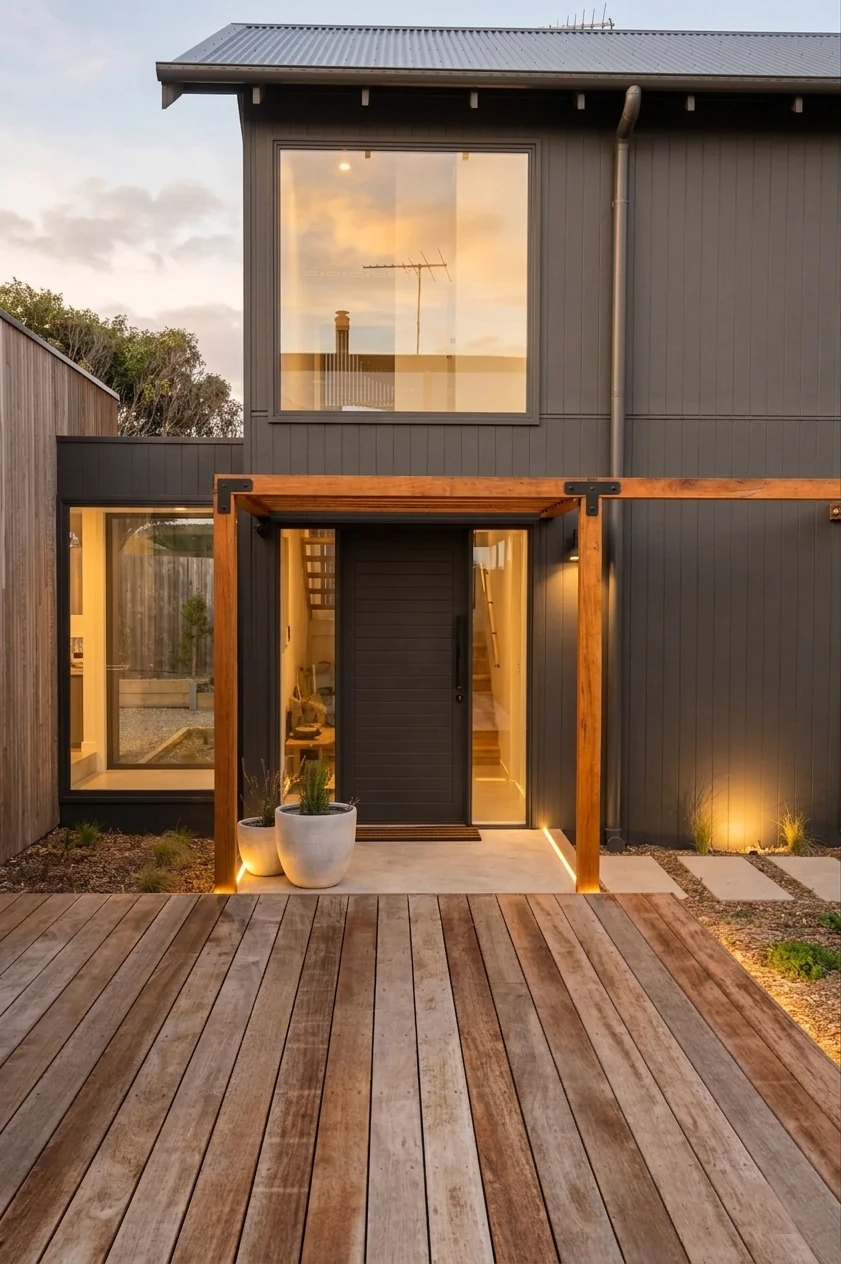
It's the question behind almost every first conversation we have: what's this actually going to cost?
It's a fair question, and the most important one you'll ask. It's also the one most builders answer vaguely — because an honest number depends on things you probably haven't nailed down yet: your block, your brief, your finishes, your timeline. So you get a range wide enough to be useless, or a low number designed to get you in the door.
This guide does the opposite. It's a straight, builder's-eye breakdown of what it costs to build a house in Melbourne in 2026 — what the per-square-metre figures actually mean, what's included and what isn't, and where your money really goes. No promises. Just the numbers we'd want if we were in your shoes.
The honest answer: $2,200–$5,500 per square metre
In 2026, building a house in Melbourne costs somewhere between $2,200 and $5,500-plus per square metre of floor area. That's a deliberately wide band, because the difference between the bottom and the top is enormous. Here's how to find your place in it.
| Tier | Cost per m² | What it buys |
|---|---|---|
| Project & entry-level | $2,200–$3,400 | Standard floor plan, good standard fittings, a builder working efficiently at scale. Liveable, but within constraints. |
| Quality custom | $3,400–$5,200 | Real design for your block, considered inclusions, a finish that still looks right in fifteen years. Where most Crowncon homes sit. |
| Premium & architectural | $5,200+ | Architect-led designs, premium materials, complex forms, bespoke joinery throughout, difficult sites. |
In total-project terms, a mid-range 250m² custom home in Melbourne generally runs $850,000 to $1.3 million for the build. Entry-level custom starts around $550,000–$850,000; genuine luxury runs past $1.3 million. All of those figures are construction only — they exclude land, and they exclude a stack of costs we'll get to below.
What "construction cost" includes — and what it doesn't
This is where confusion (and budget blowouts) usually start. When a builder quotes a construction cost, they're quoting the cost to build the structure — not everything you need to move in.
Usually in the construction contract: foundations and slab; frame, roof and external cladding; internal walls, insulation, plasterboard; windows and external doors; kitchen cabinetry and appliances (if specified); bathrooms, tiling and waterproofing; flooring (if in spec); electrical and plumbing rough-in and fit-off; internal and external painting.
Usually not included — and often not mentioned upfront: site costs; demolition (for a knockdown rebuild); landscaping, driveway and fencing; design and drafting fees; building and planning permits; utility connections (water, gas, power, NBN); window furnishings; a contingency buffer.
The one thing to remember: for most builds, these extras add $80,000–$180,000 on top of the construction contract. The contract price is not the project price. Budget for the whole thing from the start.
Site costs: the wildcard
Site costs are what it takes to make your specific block ready to build on, and they swing more than anything else on the page — from around $15,000 on a flat, well-serviced suburban lot to $80,000-plus on a sloped or complicated one.
What pushes them up: slope (excavation, retaining, engineered slabs), reactive clay soil (common in Melbourne's southeast — it needs deeper footings), tight access, and long service-connection runs for water, sewer and power. If you're building on the site of an old home, demolition is separate again — typically $15,000–$40,000, plus $2,500–$15,000 if there's asbestos, which almost all pre-1990 homes have.
Get a soil and site report before you set your budget. It converts the biggest unknown in your project into a real number, and it's the difference between a manageable build and a nasty mid-project surprise. Be wary of any builder who gives you a fixed price before they've seen it. If your block has an existing home on it, our knockdown rebuild cost guide breaks down demolition, asbestos and the full timeline.
"The contract price is not the project price. Budget for the whole thing from the start."
— Tim SwindonWhat does $850,000 actually build in Melbourne?
This is the band we work in most — homes around the $800,000–$950,000 construction mark, across southeast Melbourne's established suburbs. At that level, here's what's realistic for a family: four bedrooms and two bathrooms (master with ensuite and walk-in robe, three bedrooms with built-ins); an open-plan kitchen, dining and living zone designed properly for the block, with real natural light and indoor-outdoor flow; a quality kitchen with stone benchtops, good appliances and a butler's pantry or proper storage; a double garage with internal access; a covered alfresco connected to the main living zone; genuine thermal performance from insulation, double glazing and orientation done right; and a well-proportioned floor plan that's neither oversized nor squeezed.
What $850,000 doesn't stretch to: custom joinery throughout, extensive stone or timber cladding, a large double-storey with generous ceilings on both levels, or a complex architectural form. Those sit in the tier above.
The honest version: $850,000 in construction can produce a home you're genuinely proud of — if the design is smart and the builder knows how to get value out of the budget. It can also produce something forgettable if either of those is missing. The number matters less than what's done with it.
What's driven costs up (and where things sit now)
Construction costs in Victoria rose sharply from 2020 — labour shortages, material price jumps, and supply-chain strain all hit at once. The per-square-metre ranges in this guide reflect where things have settled in 2026.
The better news: the pace of increases has slowed a lot since the 2022–2023 spike. For buyers who held off through those years, the ground is steadier now — though it's realistic to expect costs to hold rather than fall. Building well has simply become more expensive than it was five years ago, and no honest builder will tell you otherwise.
Volume builder vs custom builder: the real comparison
A volume builder will usually quote a lower base price — often $600,000–$750,000 for a similar-sized home. So why would anyone pay more? Sometimes you shouldn't. On a flat block, with a standard plan and a predictable process, a well-run volume builder can deliver a good result.
But that base price is a floor, not a ceiling. It works by keeping inclusions lean. By the time you've upgraded the kitchen, changed the façade, chosen your own tiles and added the alfresco you actually wanted, the price has often moved $80,000–$150,000. The low number that got you in the door isn't the number you finish on.
The other difference is harder to put in a table but matters more over years: a volume builder runs hundreds of homes at once, and yours is one of many. A boutique builder carries a smaller book — which means more direct access to the people making decisions, more room to adapt when something changes, and more accountability when it doesn't. That shows up in the experience of building, and in the home you end up with.
How to budget for a build — practically
Start with land. If you own your block, good. If you're buying, add stamp duty, legals, and the cost of removing any existing structure.
Work backwards from a total, not a contract price. Your real budget is construction plus site costs, design, permits, landscaping — and a contingency. Set aside 10–15% of construction cost as buffer. Things move; the buffer is what keeps a build calm.
Get your soil report early. Before you commit to a design budget or a builder, know your site costs.
Be honest about finishes. What you specify is the single biggest lever on the final number. Decide early what matters most — kitchen, bathrooms, floors — and be pragmatic elsewhere.
Ask every builder what's not included. Site costs, external works, appliances, landscaping, blinds. A builder who gives you a clear, written answer is a builder you can plan with. It's how we work — you can see our full approach on our process page.
Common questions
How much does it cost to build a house in Melbourne in 2026?
Between $2,200 and $5,500+ per square metre for construction, depending on size and finish. A mid-range 250m² custom home generally runs $850,000–$1.3 million to build, before land and site costs.
What's the difference between construction cost and total project cost?
Construction cost is the structure. Total project cost adds site costs, permits, design fees, landscaping, connections and a contingency — usually $80,000–$180,000 more. Always budget for the total.
Why are builder quotes so different for the same-sized home?
Mostly inclusions and allowances. A low base price often carries low allowances that rise once you make real choices. Compare what's in each quote, not just the headline figure.
Is it cheaper to build or to buy an established home?
It depends on the market and your block, but building lets you get exactly what you want with no compromises — and, on a knockdown rebuild, stay in the suburb you already love.
Talk numbers with Crowncon
We're happy to have an honest conversation about budget and what's realistic for your brief — before you've committed to anything. We won't tell you what you want to hear, and we won't pretend every brief fits our scope. But if you're building in southeast Melbourne and you want a straight answer on what your home is likely to cost, we're the right people to ask.