There's a habit I see in nearly every set of concept plans that comes across my desk: everything has been custom-drawn. The door handles, the skirting profile, the wardrobe layout in the fourth bedroom, the downlights in the laundry — every single element treated as a design decision worth making from scratch. It feels thorough. It's also where a huge amount of unnecessary cost quietly gets built into a home before anyone's noticed.
Custom doesn't mean better by default. It means different from standard — and different costs money whether or not anyone will ever perceive the difference. The families who get the best outcome aren't the ones who customise the most. They're the ones who know exactly which handful of decisions are worth being custom about, and are happy to let a well-chosen standard product handle the rest.
"Every dollar of custom should buy something someone can actually feel. If it doesn't, you've paid extra for a difference nobody will ever notice."
— Tim Swindon, Director, Crowncon HomesWhat "custom" is actually for
A custom home isn't custom because every component in it was made specifically for you. It's custom because the handful of decisions that actually shape how the home feels — how it sits on the block, how the light moves through it, how the main living space works — were made specifically for you. Everything else is just a component. A door hinge doesn't know which house it's in.
The distinction matters because design fees and construction costs both scale with how many things are treated as bespoke. A kitchen island shaped to fit an unusual room and finished in a one-off stone can be worth every cent — you'll use it every day, and it's the first thing anyone notices. A custom-profiled skirting board running through six bedrooms nobody enters more than twice a day is a different kind of spend entirely. Same word, "custom." Very different return.
The test we use on every line item
When we're pricing a design with a client, every element that's been drawn as bespoke gets asked the same three questions:
Will you actually perceive the difference? Not "is it nicer" in the abstract — will you, specifically, notice it in daily use, compared with a well-chosen standard alternative sitting a few hundred dollars cheaper.
Does it carry the design intent? Some elements are doing the job the whole design was built around — the window that frames a view, the ceiling that makes a room feel taller, the joinery that makes an awkward space work. Compromise there and you've compromised the reason the design exists. Everything else is supporting cast.
Would a standard product need to be hidden or excused? If the honest answer is "you'd never know," that's the strongest sign you're looking at a safe place to save money. If the honest answer is "it would look obviously cheaper," that's a sign the custom spend is doing real work.
Where this actually happens: at the pre-design stage, before a designer has drawn a single wall — which is why we start every Bespoke Series project with a budget conversation, not a mood board. It's also why the Considered Series exists at all: start from a plan where those calls have already been made properly, then adjust the handful of things that matter to you.
Where Tasman spent its budget — and where it didn't
Our Tasman project in Rye is the clearest example we've built. It's a 360m² home with a genuinely bespoke brief, and it carries a cathedral ceiling with exposed feature rafters, a raked double-glazed window set above a commercial-grade sliding door, and reverse living specifically arranged to put the Bass Strait views where the family actually sits. None of that is negotiable custom work — it's the reason the design exists, and every dollar spent on it is a dollar the owners feel every single day.
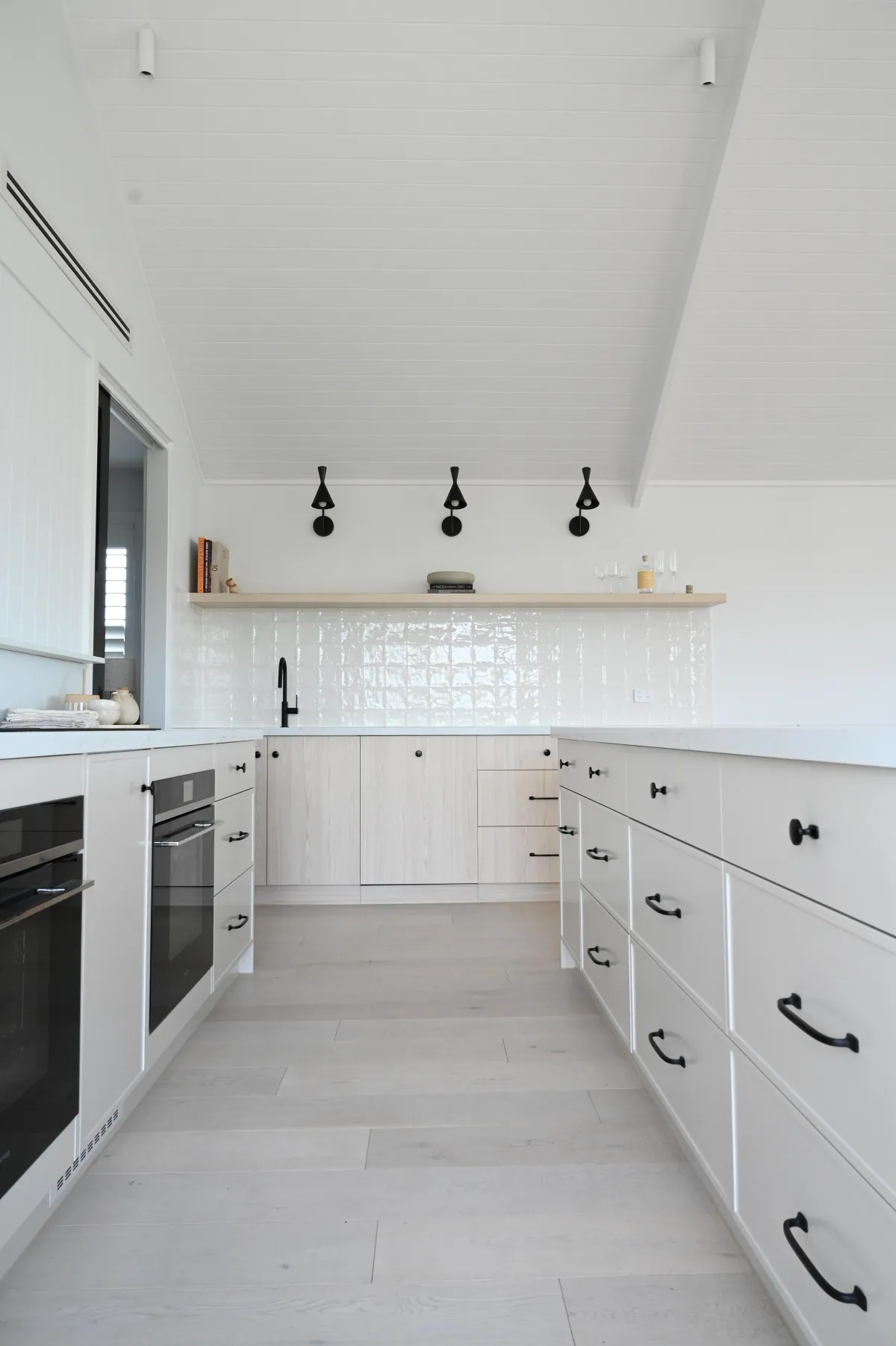
Walk into the kitchen, though, and the joinery runs on a standard cabinetry system with a considered material and hardware selection over the top — the photo above this article is that kitchen. It reads as custom because the finish, the lighting and the layout were chosen with care. It didn't need a bespoke joiner building one-off carcasses to get there. The budget that wasn't spent on the parts nobody would ever notice went straight into the parts of the home that make Tasman what it is.
How this actually plays out on your plans
In practice, the split usually lands somewhere close to this:
Worth being genuinely custom: the elements that define how the home works and feels — an unusual site response, a signature window or ceiling moment, a kitchen or living layout built around exactly how your family uses the space, and any joinery solving a specific problem a standard product can't.
Rarely worth it: door and window hardware, standard sanitaryware, downlights and switch plates, skirting and architrave profiles, wardrobe fit-outs in secondary bedrooms, and most cabinetry carcasses once you're choosing a good door profile and finish over the top. A well-specified standard range does the identical job at a fraction of the cost, and almost nobody can tell the difference once it's installed and styled.
This isn't a checklist you can apply generically, though — it depends on your specific brief, your block, and what actually matters to your family. That's exactly the conversation a design-and-build team should be having with you before a single wall goes on paper, not after the drawings come back over budget.
If you've already got concept plans
If you're reading this with a set of drawings already in hand — you've paid for concept plans, you like the design, and you're weighing up whether to fund the next stage — this is precisely the moment to get a detailed price before you commit further. We'll go through the plans line by line, tell you honestly where the design is earning its cost and where it isn't, and give you a real number before you spend another dollar on documentation. It costs you nothing to ask, and it's a much better time to find out than after the next stage is paid for.