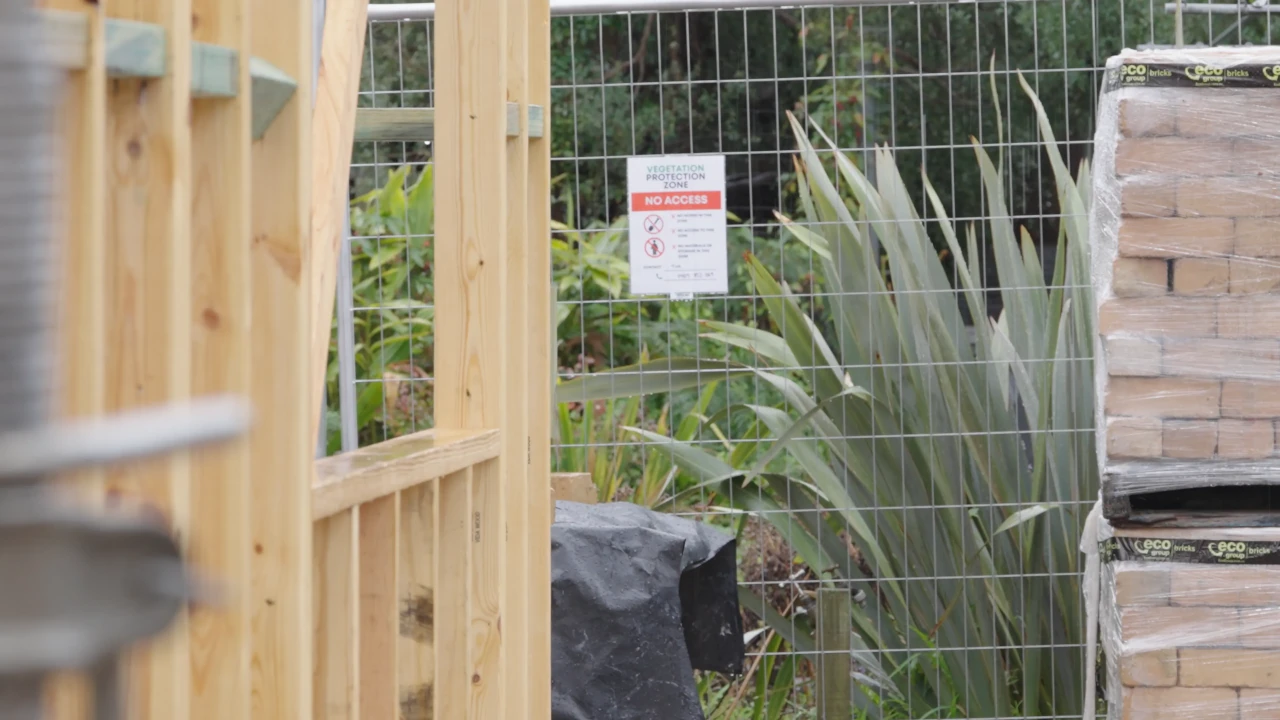
A tree protection zone is the area around a tree that has to stay undisturbed while you build, so the roots and trunk survive the process. It's calculated as 12 times the trunk diameter measured at 1.4 metres above ground, expressed as a radius from the centre of the trunk. If your block has one, it shapes where machinery can go, where you can excavate, and sometimes the footprint of the house itself.
That's the short version. The longer version matters more, because the rules around tree protection zones in Victoria changed in September 2025, and a lot of people planning a knockdown rebuild are still working off the old ones.
How a tree protection zone is calculated
Measure the trunk diameter at 1.4 metres above ground. Multiply by 12. That's your radius.
If you'd rather not do it on the back of an envelope, our tree protection zone calculator takes either a diameter or a circumference, applies the standard's minimum and maximum, and works out the structural root zone and your encroachment percentage at the same time.
So a fairly ordinary backyard gum with a 400mm trunk carries a protection zone extending 4.8 metres in every direction from the trunk. A larger established tree with a 700mm trunk carries one of 8.4 metres. On a typical Bayside block, one mature tree in the wrong position can put a protected circle across a meaningful share of your buildable area.
Inside a tree protection zone you can't excavate, store materials, park machinery, run vehicles, or change ground levels without an arborist signing off on it. Root damage doesn't announce itself either — a tree that has had its root zone compacted by a bobcat can look completely healthy for two or three years and then die, long after everyone has left site.
A note on the standard. The 2025 revision of AS 4970 introduced a separate root zone term, the NRZ, covering the roots and soil, while the TPZ continues to describe above-ground protection. It also replaced diameter at breast height with diameter at standard height — still measured at 1.4m — and split the old tree management plan into a Tree Protection Plan and a Tree Protection Specification. The calculation is unchanged: still 12× the trunk diameter at 1.4m, with the standard's 2m minimum and 15m maximum radius. If your arborist's report uses different terms to the ones your council's website does, that's why.
Encroachment into a tree protection zone is graded rather than banned outright. As a rule of thumb, up to 10% is treated as minor and usually acceptable, 10–20% is moderate and needs justifying with a design response, and anything past 20% is major and will need serious arboricultural support to get through council. That grading is the practical lever — it's often the difference between moving a wall 600mm and losing a tree entirely.
Clause 52.37: the rule that changed in September 2025
On 15 September 2025, Amendment VC289 introduced Clause 52.37 Canopy Trees into every planning scheme in Victoria. This is the change most homeowners haven't caught up with, and it applies whether or not your block carries an overlay.
A tree is a canopy tree under Clause 52.37 if it meets all three of these:
| Measure | Threshold |
|---|---|
| Height | More than 5 metres |
| Trunk circumference | More than 0.5 metres, measured at 1.4m above ground |
| Canopy diameter | At least 4 metres across |
Half a metre of circumference is only about a 160mm trunk. That is not a big tree. Plenty of twenty-year-old suburban plantings clear all three thresholds comfortably.
Where it applies, you need a planning permit to remove, destroy or lop a canopy tree:
On a vacant lot — anywhere on the block.
On a developed lot — within 6 metres of the street frontage and within 4.5 metres of the rear boundary.
The clause covers the General Residential, Neighbourhood Residential, Residential Growth, Mixed Use, Township, and Housing Choice and Transport zones. The Low Density Residential Zone is excluded.
There's a detail in that which catches people out on a knockdown rebuild. Once the existing house comes down, the argument about whether your lot is "vacant" gets a lot more interesting — and the vacant-lot trigger applies across the whole block, not just the boundary strips. The order in which you demolish and apply is not a trivial question. Sort the tree position out at design stage; redesigning around a tree is almost always faster and cheaper than arguing for its removal.
The overlays that sit on top
Clause 52.37 is a floor, not a ceiling. It doesn't override anything already on your title.
Vegetation Protection Overlay (VPO). Applied by councils to areas where vegetation is considered significant to neighbourhood character. Where a VPO applies, you need a planning permit to remove, destroy or lop vegetation — frequently including trees well below the canopy tree thresholds.
Significant Landscape Overlay (SLO). Similar mechanism, different purpose — it protects the landscape character of an area rather than individual vegetation. Common through Melbourne's leafier established suburbs.
Significant tree registers. Several councils maintain their own registers of individually protected trees. A tree on a register is effectively untouchable without a specific application.
Neighbourhood character overlays. These don't protect trees directly, but they frequently reference the vegetated character of a street — which means removing a prominent tree can weaken an application that would otherwise have been straightforward.
Any of these can apply to a block that looks completely ordinary from the footpath. This is exactly why the overlay check belongs before you commission a design, not after. Our free feasibility check runs your address against Victoria's official planning data and returns the overlays on your block in under a minute.
What it actually costs to keep a tree
Protecting trees isn't free, and any builder who tells you otherwise is going to find the money somewhere else. The honest list:
The arborist report. A basic tree assessment is the cheap version. An arboricultural impact assessment supporting a planning permit is more, because it has to model the effect of the proposed build on each protected tree and specify the protection measures. Council will usually tell you which one they want. Either way it's a small number relative to what it saves you, because it tells you whether a tree constrains your footprint while the design can still change cheaply.
Protective fencing. Physical exclusion fencing around each tree protection zone, in place before demolition starts and standing until the last trade leaves.
Access and plant. This is the big one, and it's the one nobody quotes for until it's too late. If a tree protection zone sits across the only route onto the block, materials have to be placed rather than driven in — which usually means a crane instead of a truck, and often more deliveries in smaller loads.
Program time. A constrained site is a slower site. Sequencing takes longer when half the block is fenced off.
The asset protection permit. Separate from tree protection, but connected — because street trees on the nature strip are council assets too. In the City of Kingston the permit is $350, with a refundable security bond of $2,000 on works under $100,000 and $5,000 between $100,000 and $1 million. Damage to the nature strip, footpath, kerb or street trees has to be reinstated to council's specification before the bond comes back.
What this looked like on our Moorabbin build
The owners of our current Moorabbin knockdown rebuild have been on that block for about thirty years. They planted the gum at the back themselves. Another tree has only just started fruiting. Through the rest of the garden are plants they brought in from interstate years ago and nursed back to health — the kind you can't simply go and buy again.
So protecting the garden wasn't a preference on this job. It was one of the criteria the design had to meet, and it shaped three decisions:
We rebuilt in the existing footprint. Repositioning the house would have given us a freer hand on the design and cost the garden. The footprint stayed.
We fenced the garden off before anything started. Not at demolition — before it.
We brought cranes in instead of trucks. Materials get picked and placed from a distance rather than reversed up the block, which keeps plant and stored materials outside every tree protection zone on the site. It costs more and it makes the site harder to work.
"They can move back in and still have a well-established garden. Not just a blank block and blank grass."
— Tim SwindonIt didn't all go perfectly. Between twelve-metre roof trusses and a tree on the verge, the crane clipped the corner of the neighbour's nature strip getting onto the block, and chewed it up. We've seeded it, it's taking, and we'll scrape it back and lay fresh turf at the end. That's written up honestly, damage and all, in the Moorabbin build journal — which is the whole point of running a live journal rather than a gallery of finished photos.
Common questions
What is a tree protection zone?
The area around a tree that must stay undisturbed during construction. Calculated as 12× the trunk diameter measured at 1.4m above ground, as a radius from the trunk centre. No excavation, storage, machinery or level changes inside it without arborist sign-off.
How do you calculate a tree protection zone?
Trunk diameter at 1.4m × 12 = the radius. A 400mm trunk gives a 4.8m radius. AS 4970's 2025 revision renames it the Notional Root Zone but the maths is the same.
Do I need a permit to remove a tree before a knockdown rebuild in Victoria?
Frequently yes. Since 15 September 2025, Clause 52.37 protects canopy trees across most residential zones — over 5m tall, trunk circumference over 0.5m at 1.4m, canopy 4m or wider. Permit needed anywhere on a vacant lot, or within 6m of the street frontage and 4.5m of the rear boundary on a developed lot. Overlays and significant tree registers apply on top.
What is a Vegetation Protection Overlay?
A council planning control over areas where vegetation is significant to neighbourhood character. Where one applies you need a planning permit to remove, destroy or lop vegetation, often including trees below the Clause 52.37 thresholds. A Significant Landscape Overlay does a similar job for landscape character.
How much does an arborist report cost in Melbourne?
Depends on scope. A basic assessment is cheaper than an arboricultural impact assessment supporting a planning application, which has to model the build's effect on each protected tree. Council will usually specify which they require.
Can you build around an established garden?
Yes, with constraints and cost. Same footprint, protective fencing before demolition, and placing materials by crane instead of driving them in. That's what we did in Moorabbin, and it's why those owners will move back into a mature garden instead of a bare block.
What to do before you commit
Three things, in order.
Check your overlays before you pay for a design. A VPO or SLO discovered after concept design is an expensive redraw. Discovered before, it's just a constraint the designer works with.
Measure your trees. Trunk circumference at 1.4m, rough height, rough canopy spread. Five minutes with a tape tells you which trees are in scope under Clause 52.37 — and whether the ones you assumed you'd remove are actually removable.
Ask your builder how they handle protected trees. Specifically: is the arborist report inside the fixed price, is tree protection zone fencing, and what happens to the quote if access has to change from trucks to a crane. A builder who hasn't thought about it will tell you it'll be fine. A builder who has will tell you what it costs.
If you're weighing up a knockdown rebuild in Bayside or South East Melbourne and there are trees on the block you'd rather keep, we're happy to walk it through plainly — including the parts that cost money. More on how we run knockdown rebuilds, or have a chat with Tim.
Planning controls summarised here are general guidance current at August 2026, sourced from the Victoria Planning Provisions, Amendment VC289 and council published material. Overlays, permit triggers and fees vary by council and by block — a specific site still needs a specific check.