Most knockdown rebuild budgets don't blow out on the build. They blow out on everything the headline number doesn't reach.
Our full knockdown rebuild cost guide covers the costs you can price before you start: demolition, asbestos, site costs, the new home, rent and permits. This article covers the layer underneath. These are the costs that only appear after you've signed, that sit outside your builder's contract, or that never make it into a table at all. If you've searched for the hidden costs of a knock down rebuild, this is the list we'd want a friend to read before they signed anything.
The short version. Five places: the ground (what's under the old house), the contract (provisional sums and exclusions), fees and bonds paid straight to councils, time (rent and interest while the program slips), and everything after handover. For most builds, the extras that sit outside the construction contract add $80,000–$180,000 on top of the contract price. The contract price is not the project price.
1. The ground: what the site report can't see
A soil report tells you what your block is made of. It gives you the site classification that decides your footings. It doesn't tell you what's been put in the ground since. On a knockdown rebuild the block has been lived on for fifty or eighty years, and every owner in that time did something to it.
Old services and drains. Disused sewer connections, redundant drains and stormwater lines that don't go where the plans say. If a sewer main or easement runs through the block, it can decide where the house is allowed to sit. That's a design cost long before it's a construction cost.
Fill and buried material. Uncontrolled fill, old slabs and buried debris from sheds and extensions long gone. Soil that leaves your block has to go to a facility licensed to take it, and how it's classified under EPA Victoria's waste categories decides what that costs per tonne.
Asbestos beyond the house. Fibro sheds, old fencing and fragments in garden soil are common on pre-1990 blocks. The $2,500–$15,000+ in our cost table covers the house. Fragments found in the soil are what push it toward the "plus".
Ground that changes between the test points. A soil report samples a handful of locations on your block. Reactive clay is common across the south-east and the report deals with it. Rock, or a soft patch where an old structure stood, can sit between the test points.
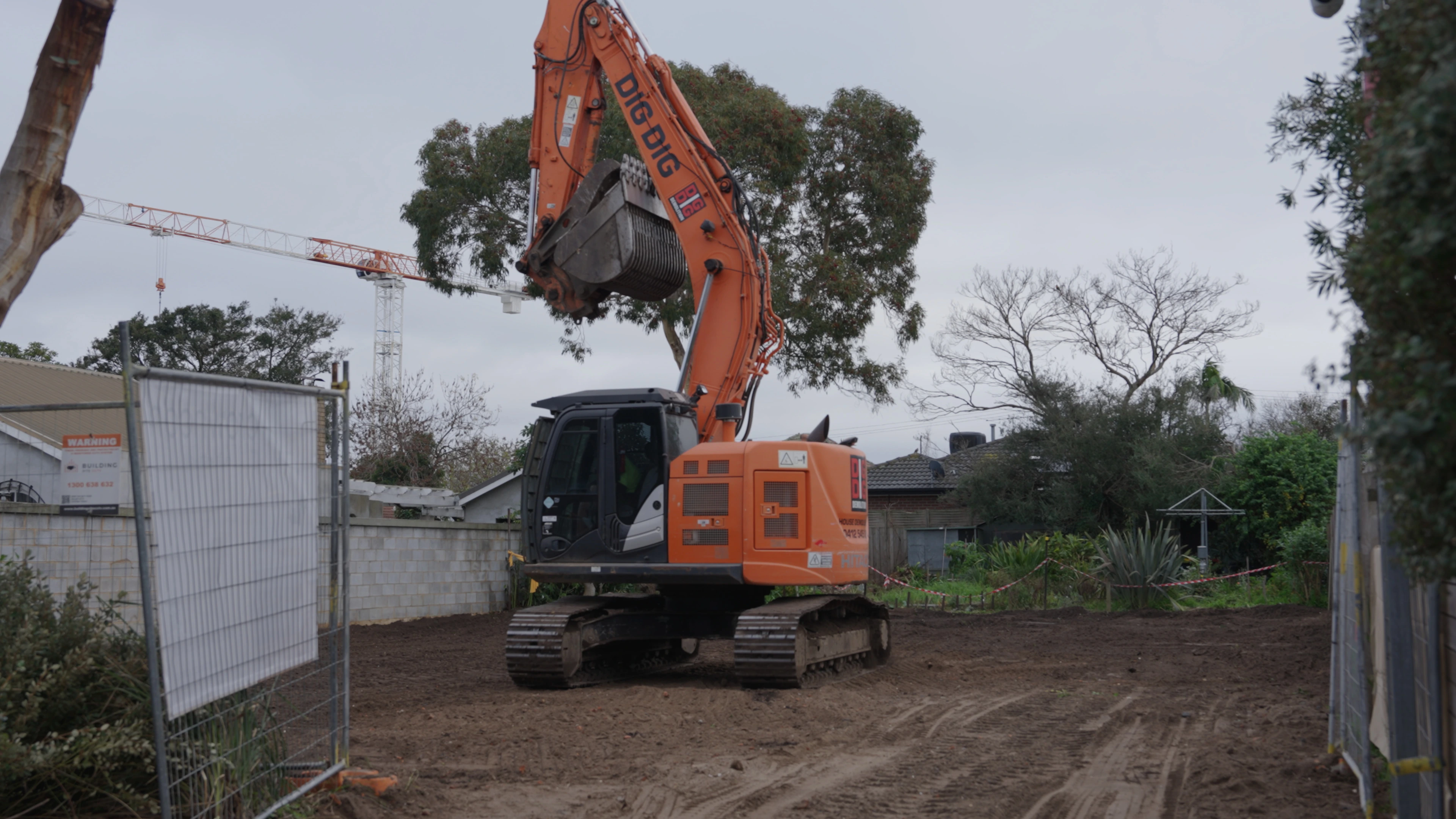
Tree roots. A protected tree can move your footprint or change how machinery reaches the block. On our Moorabbin build it meant cranes instead of trucks. We've covered how that's calculated and what it costs, and you can run your own numbers through the tree protection zone calculator.
The only real defence is to look before you sign. That's why our feasibility stage checks zoning, overlays, easements, soil and slope against your address and tests for asbestos before anyone commits to a number. Whatever genuinely can't be known until the old house is gone belongs in the contract as a clearly named provisional sum. Which brings us to the contract.
2. The contract: allowances, provisional sums and exclusions
Two terms decide more building budgets than any others. A prime cost (PC) item is an allowance for something you'll choose, like a kitchen, tapware or tiles. A provisional sum (PS) is an allowance for work that can't be priced yet, like rock excavation or a retaining wall that depends on final site levels. In both cases the contract price moves to the actual cost, and if the allowance was too low, the shortfall is yours.
A low allowance isn't always dishonest. Often it's just a decision nobody has finished making. But it's also how one quote ends up cheaper than another on paper. Before you compare two prices, compare what's fixed and what's an allowance inside each.
| Where it hides | What to ask | Why it moves the number |
|---|---|---|
| Provisional sums | Which items are provisional, what is each based on, and what happens if it's exceeded? | A provisional sum with no basis is a guess with your name on it. |
| Prime cost items | What does each allowance actually buy: brand, size, supplied and installed? | Kitchens, bathrooms and flooring are where allowances run short. |
| Exclusions | Can I have a written list of what isn't in the price? | Landscaping, driveway, fencing, window furnishings and connections are usually outside. |
| Site costs | Are they fixed or provisional, and based on which report? | The widest-swinging line in the budget: $15,000 to $80,000+. |
| Variations | How are changes priced, and who has to sign? | This is where a fixed price gets a second life. |
| Statutory costs | Which permits, levies, bonds and insurances are inside the price? | Some are cash you pay out on top. |
| Delay | What happens to the program, and my rent, if approvals slip? | See section 4. |
3. Fees, bonds and permits paid outside the contract
Some costs never touch your builder's invoice. Councils and authorities charge you directly, and the amounts vary by council. Kingston is a useful example because it publishes its figures clearly (checked September 2026; fees are indexed each year, so confirm with your own council).
Asset protection permit and bond. Kingston charges $350 for the permit, plus a refundable security bond: $5,000 for works between $100,000 and $1 million, $7,500 between $1 million and $5 million. It covers roads, footpaths, nature strips, kerbs, drains and street trees. If anything is damaged and not reinstated to council's specification before the final inspection, the bond is withheld. A knockdown rebuild, with trucks, skips and often a crane, is exactly the kind of job that puts it at risk, and the money is tied up for the whole build either way.
On our Moorabbin build, the crane clipped a neighbour's nature strip getting onto the block. It's a small thing, and it's exactly the kind of cost that appears in no quote. We've seeded it, and it's taking. We'll re-turf at the end. It's written up, damage and all, in the Moorabbin build journal.
Tree permits. Since September 2025, Clause 52.37 requires a planning permit to remove a canopy tree within 6 metres of the street frontage or 4.5 metres of the rear boundary on a developed lot. Some councils add a local law on top. Kingston's charges $130 per tree.
Protection work. If demolition or excavation could affect a neighbour's property, the Building Regulations require a protection work notice to the adjoining owner (regulation 113). The temporary works that go with it are typically part of your project scope and your cost.
A planning permit, if an overlay triggers one. The fee matters less than the calendar. Blocks with a neighbourhood character, heritage or flood overlay need one, and it adds roughly three to six months. Which is a cost of a different kind.
Put a number on it. Our knockdown rebuild cost calculator takes your size, finish level and site conditions and gives you a starting range in a couple of minutes. It's built from the ranges in our cost guide, so it won't contradict anything on this page.
4. Time: the cost with no table
Rent is in our cost table at $8,000–$25,000. What isn't in any table is what happens to that figure when the program moves. You can't live on site, so every month of delay is another month of rent while your mortgage carries on. If you're funding the build with a construction loan, interest also builds as each stage is drawn.
Illustration only: at $3,000 a month in rent, a planning permit that adds three to six months costs you $9,000 to $18,000 before demolition has even started. Add storage for your furniture and two moves instead of one, and the rent line stops looking like a line and starts looking like a project of its own.
The cheapest delay is the one you find early. Checking your overlays before you commission a design, rather than after, is the single biggest thing you can do about this one. We walk through how in Is My Land Suitable for a Knockdown Rebuild?
5. After handover: the budget that starts when the build ends
Landscaping, driveway, fencing, window furnishings, and any appliances or floor coverings that weren't specified. Most contracts exclude at least some of these, and owners tend to remember them last, by which point the money's already been spent. Budget for them at the start, in the same spreadsheet as everything else.
How to find them before they find you
Four things, in order.
Get the reports before the contract. Soil report, site survey, asbestos testing, and an arborist's assessment if there are trees. Each one converts an unknown into a number while you can still change the design.
Get every allowance and exclusion in writing. Every prime cost item, every provisional sum, and every exclusion, along with what each is based on. A builder who won't put it in writing is telling you something.
Budget time as money. Put months multiplied by your rent and your existing repayments into the plan, then hold a contingency separate from the contract. The right size depends on how much of your block is still unknown.
Ask every builder the same three questions. What's not in this price? What's provisional, and why? What happens to the program if approvals or ground conditions change?
If you're weighing up a knockdown rebuild in Bayside or South East Melbourne, we're happy to walk you through the parts of the number nobody puts on the brochure, including the parts that cost money. See how we run knockdown rebuilds, or have a chat with Tim.
Common questions
What are the hidden costs of a knock down rebuild in Victoria?
Five things sit outside a typical cost table: ground conditions you can't see until the old house is gone (buried services, fill, asbestos beyond the house, rock), provisional sums and exclusions in the building contract, fees and bonds paid directly to councils and authorities, rent and interest while the program slips, and landscaping, driveway, fencing and furnishings after handover. Crowncon's cost guide puts the extras outside the construction contract at $80,000 to $180,000 for most builds.
Is a fixed-price building contract really fixed?
Not automatically. A fixed price still moves for prime cost items, provisional sums and approved variations. The practical question is how much of your project is fixed and how much is an allowance. Ask for every prime cost item and provisional sum in writing, along with what each one is based on.
What is a provisional sum in a building contract?
A provisional sum is an allowance for work that can't be priced accurately at contract stage, such as rock excavation or a retaining wall that depends on final site levels. If the real cost is higher, the contract price rises by the difference. A prime cost item is similar but covers something you will choose, such as a kitchen or tiles.
How much contingency should I hold for a knockdown rebuild?
There is no single figure. A common rule of thumb is to hold 5 to 10 per cent of the total project cost, separate from the building contract, and to lean toward the top of that range where the ground is unknown: a pre-1990 house, a sloping block, mature trees or a history of extensions. Reports done before you sign narrow the range.
Do I get the council asset protection bond back?
Yes, if council-owned assets are left undamaged or are reinstated to council's specification before the final inspection. Kingston's published figures, as an example, are a $350 permit fee and a refundable bond of $5,000 for works between $100,000 and $1 million, or $7,500 for works between $1 million and $5 million. If roads, footpaths, nature strips, kerbs, drains or street trees are damaged and not reinstated, the bond is withheld.
Figures and rules summarised here are general guidance current at September 2026, drawn from published council material, the Victoria Planning Provisions and the Building Regulations 2018. Kingston figures are an example only. Fees are indexed and vary by council and by block. A specific site still needs a specific check.